
What Is Query Fan-Out in AI Search? A Practical SEO Guide
Learn what query fan-out is, why Google AI Mode and AI search use it, and how small businesses can turn fan-out questions into better SEO content.

TL;DR
Query fan-out is the process where an AI search system turns one user query into several related sub-queries, searches or retrieves information for those sub-queries, then synthesizes the answer from multiple sources. Google says AI Overviews and AI Mode may use query fan-out by issuing multiple related searches across subtopics and data sources.
For SEO, this means your page is not only competing on one keyword anymore. It needs to answer the surrounding questions an AI system may generate behind the scenes. In a Semrush study of 5,000 keywords and more than 150,000 citations, Google AI Mode sidebar links had only 32% URL overlap with Google’s top 10 organic results, which suggests AI citations are related to classic rankings but not identical to them.
The practical move is simple:
- Start with the target keyword or user question.
- Generate the likely fan-out questions behind it.
- Group those questions by intent.
- Turn the important ones into headings, short answer blocks, FAQs, or supporting articles.
- Track whether those updates increase AI citations and traditional search visibility.
DataWise’s Fan-out Queries tool is built for this exact workflow: take one seed query, reveal the sub-query cluster, and turn it into a page brief or content cluster.
Sources used in this guide include Google’s AI features documentation, Google’s AI Mode announcement, Semrush’s query fan-out explainer, and Semrush’s AI Mode comparison study.
The small business advantage
Most businesses only look at the final AI search answer. The better opportunity is the hidden question map behind that answer.
AI search does not just respond to one keyword. Google says AI Mode is particularly useful for queries involving exploration, reasoning, or complex comparisons, and both AI Mode and AI Overviews may use query fan-out to issue multiple related searches. If a small business answers those related questions in detail before competitors do, it gives AI search systems better source material to evaluate when people ask about that niche.
The practical workflow is simple:
- Find the fan-out questions behind the search.
- Export them to the content writer.
- Add your own experience, examples, screenshots, customer conversations, and product observations.
- Create educational content that answers the fan-out in detail.
- Keep the page useful first, not salesy first.
That last part matters. Generic AI content can copy a definition. It cannot copy the real experience of a business owner who has seen the same objections, questions, and mistakes from actual customers.
Why query fan-out matters now
Classic SEO trains you to ask: “What keyword should this page rank for?”
AI search forces a better question: “What set of questions does the engine need answered before it can trust this page as a source?”
Google’s Search Central documentation says AI Overviews and AI Mode may use a query fan-out technique, which means issuing multiple related searches across subtopics and data sources. Google also says AI Mode is designed for deeper reasoning and follow-up questions, while its Deep Search feature can issue hundreds of searches to create a fully cited report. In the same announcement, Google said AI Overviews drove an over 10% increase in Google usage for query types where AI Overviews appear in major markets like the U.S. and India, based on internal data from September 2024 through April 2025.
That changes the job of an SEO page. A page can rank for the head keyword and still miss the answer if it does not cover the supporting questions. Semrush found that Google AI Mode sidebar links had 51% domain overlap and 32% URL overlap with Google’s top 10 organic results in its 5,000-keyword study, so classic rankings still matter, but they do not fully explain AI Mode citations. The page has to be useful for the main topic and specific enough for the subtopics.
This is why query fan-out sits between classic keyword research and modern AI visibility:
- Keyword research tells you what people type.
- Competitor analysis tells you who already wins the SERP.
- AI visibility tracking tells you whether AI systems cite you today.
- Query fan-out tells you which sub-questions your page needs to cover to become citation-worthy.
What is query fan-out?
Query fan-out is an AI search technique where the system decomposes a user’s query into multiple related searches before generating the final answer. Google describes this as issuing multiple related searches across subtopics and data sources, and Semrush defines query fan-out as splitting a user query into multiple sub-queries, collecting information for each one, and merging that information into one response.
A simple example:
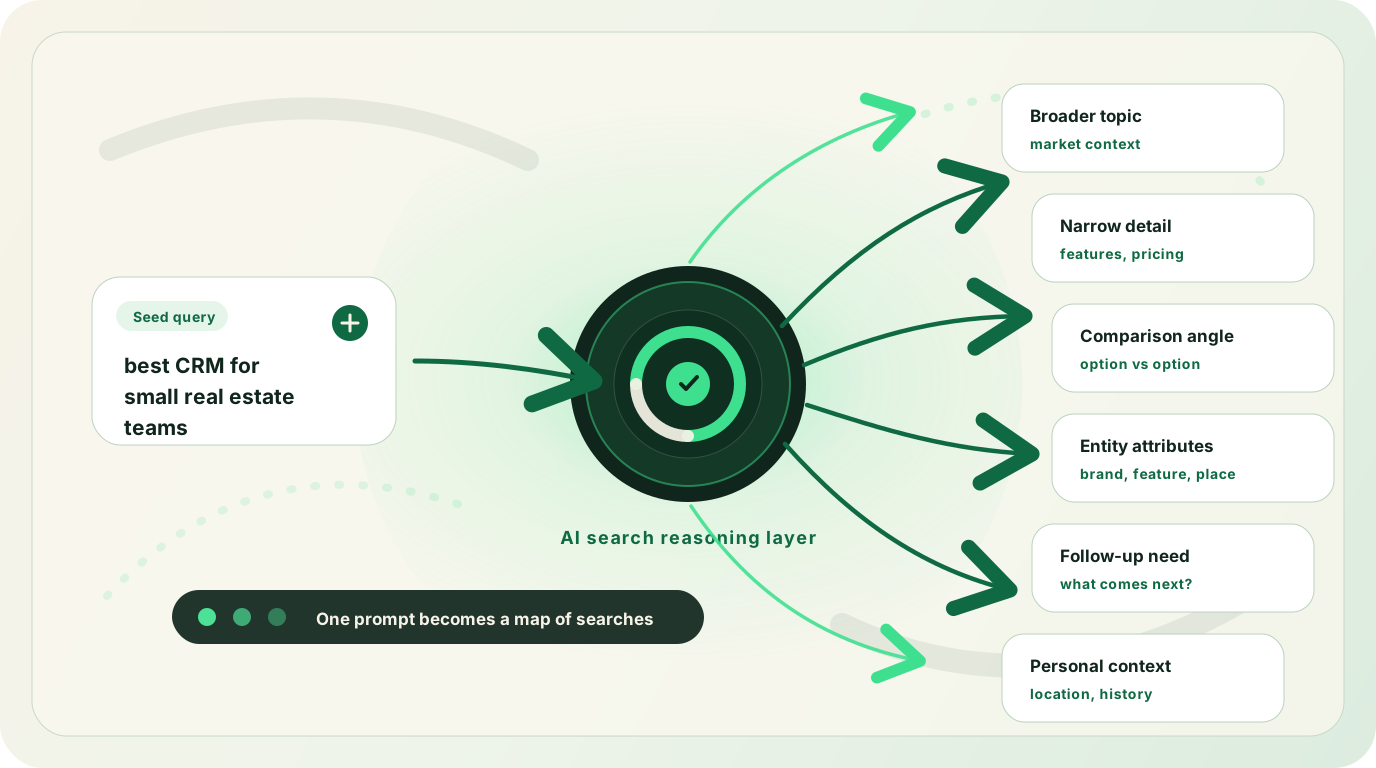
User query: “best CRM for small real estate teams”
Possible fan-out queries:
- What CRM features do small real estate teams need?
- Which CRMs support lead routing for agents?
- What is the price of the top real estate CRMs?
- Which CRMs integrate with real estate portals?
- What CRM is best for solo agents versus small brokerages?
- What are common complaints about real estate CRMs?
The AI system may retrieve evidence for several of those sub-queries, compare sources, then generate one answer. In Google’s own framing, AI Mode is built for questions that need reasoning or complex comparisons, and Semrush’s query fan-out explainer shows examples where AI Mode visibly runs multiple searches from one prompt.
That is the point. Query fan-out lets AI search behave more like a researcher than a keyword matcher.
How query fan-out works in Google AI Mode and AI search
The exact systems are proprietary, but the public explanation and observed behavior point to a common pattern.
1. The engine interprets the query
First, the AI system decides what kind of answer the user needs. Is it a comparison, a how-to, a definition, a shopping recommendation, a local search, or a troubleshooting question?
A vague query like “AI SEO tools” may imply several possible intents:
- definition
- tool comparison
- pricing
- use cases
- best tools for small businesses
- whether AI SEO tools are worth it
2. The engine generates sub-queries
Next, the system expands the query into related sub-queries. Google has publicly described AI features as issuing multiple related searches across subtopics and data sources. Semrush quotes Google’s I/O explanation that AI Mode can break a question into different subtopics and issue a multitude of queries simultaneously.
This can include:
- broader topic questions
- narrower detail questions
- comparison angles
- entity and attribute questions
- follow-up questions the user is likely to ask next
- personalized angles based on context, location, or past behavior
3. The engine retrieves passages from multiple sources
AI search systems do not only behave like a classic 10-blue-link ranking page. Google says its advanced models can identify additional supporting pages while responses are being generated, allowing AI features to show a wider and more diverse set of helpful links than classic search.
That is why clean structure matters. A page with one clear section answering “How often should I check rankings?” is easier to retrieve than a page that buries the answer in a 2,500-word wall of text.
4. The engine reranks and synthesizes
After retrieval, the system decides which sources best support the answer. Sources may be selected because they are authoritative, fresh, specific, consistent with other sources, or useful for a particular sub-query.
Then the answer is synthesized into one response, sometimes with citations and sometimes with only implied source use. Semrush found that 92% of Google AI Mode responses in its study included a sidebar with links, with about seven unique domains on average.
What query fan-out changes for SEO
The biggest change is that a page can lose visibility without being “bad” in the classic SEO sense.
It may have:
- a decent title
- solid keyword usage
- acceptable backlinks
- a first-page traditional ranking
But if it only answers the head query and misses the surrounding fan-out questions, AI search may choose other sources for the synthesized answer. Semrush’s study found Google AI Mode had about 54% domain overlap and 35% URL overlap with Google’s top 10 results overall, meaning some AI Mode sources come from outside the traditional top-ranking URLs.
Old SEO question
“Can this page rank for the primary keyword?”
Better AI search question
“Can this page answer the cluster of questions the AI system generates from the primary keyword?”
That does not mean keyword research is dead. It means keyword research is incomplete unless it becomes a content architecture workflow.
A query fan-out should inform:
- page headings
- FAQ sections
- comparison tables
- internal links
- supporting articles
- product-led examples
- schema opportunities
- refresh priorities for existing posts
Query fan-out versus People Also Ask
People Also Ask is visible. Query fan-out is mostly invisible.
People Also Ask shows questions Google has clustered around a query in the standard SERP. Those questions are useful, but they are not the full reasoning trace of an AI answer. Google’s documentation describes query fan-out more broadly as multiple related searches across subtopics and data sources, not just a visible list of related user questions.
Query fan-out can include questions that never appear as People Also Ask results because they are not necessarily popular user queries. They may be intermediate reasoning steps the AI system needs to answer the larger question.
Example:
Primary query: “best backlink analysis tool for small businesses”
People Also Ask might include:
- What is a backlink analysis tool?
- Which tool is best for backlinks?
- Is Ahrefs worth it?
Fan-out might include:
- Which backlink metrics matter for small sites?
- What features are unnecessary for small businesses?
- How much should a small business pay for backlink analysis?
- Can a low-authority site compete without expensive link data?
- What workflow turns backlink data into action?
The second set is more useful for building a page that can win AI citations, because it covers the decision process, not just the visible SERP questions. This matters because Google says AI Mode is especially helpful for exploration, reasoning, and complex comparisons, which are often broader than the questions visible in People Also Ask.
How to use query fan-out to write a better blog outline
Here is the practical workflow I would use for a DataWise or small business SEO page.
Step 1: Start with a real seed query
Do not start with a vague topic like “SEO.” Start with a specific seed query that maps to a page.
Good examples:
- What is query fan-out in AI search?
- How do I find low competition keywords with buyer intent?
- What should an SEO site audit include?
- How often should I check keyword rankings?
The seed query should be specific enough that one article can answer it properly.
Step 2: Generate the fan-out cluster
Use DataWise Fan-out Queries to generate the sub-query cluster behind the seed.
For this article, the likely fan-out includes:
- How does query fan-out work?
- Why does Google AI Mode use query fan-out?
- How is query fan-out different from keyword research?
- How is query fan-out different from People Also Ask?
- What does query fan-out change for SEO?
- How do I optimize content for fan-out queries?
- Should fan-out questions become headings or FAQs?
- How do I measure whether fan-out optimization worked?
Step 3: Group questions by intent
Not every fan-out query deserves a separate heading. Group them first.
Definition
What is query fan-out?
Best format: short answer near the top.
Mechanics
How does AI Mode fan out a query?
Best format: process section.
SEO impact
What changes for content strategy?
Best format: practical analysis section.
Workflow
How do I optimize for it?
Best format: step-by-step guide.
Comparisons
Fan-out vs keyword research vs PAA
Best format: comparison section.
Objections
Can it replace keyword research?
Best format: FAQ.
Use this grouping to decide what deserves a heading, what belongs in an FAQ, and what should become a separate supporting article.
Step 4: Decide what belongs on the page versus in the cluster
This is where most AI SEO content gets bloated.
A page about “what is query fan-out” should answer the definition, mechanics, SEO impact, and first workflow. It should not also become a 5,000-word guide to every possible AI visibility tactic.
Supporting articles should handle narrower questions like:
- How do I use fan-out queries to write better blog outlines?
- Should fan-out questions become headings, FAQs, or separate articles?
- How do fan-out queries help pages earn AI citations?
- Can fan-out queries replace keyword research?
That gives the site a clean content castle instead of one overloaded pillar page.
Step 5: Turn fan-out questions into page structure
A practical structure for this article:
- TL;DR
- What is query fan-out?
- How query fan-out works in AI search
- Why it matters for SEO
- Query fan-out versus People Also Ask
- Query fan-out versus keyword research
- How to optimize a page for fan-out queries
- How DataWise helps
- FAQ
This structure mirrors the likely sub-query cluster, which makes the article easier for users and AI systems to parse.
How to optimize a page for query fan-out
Use fan-out as a content quality system, not as a prompt gimmick. Google’s public guidance for AI features still points back to the fundamentals: pages need to be indexed, eligible for snippets, technically accessible, and genuinely helpful.
1. Add a clear answer block near the top
Give the definition or answer immediately. AI systems and users both benefit from concise answer blocks.
For example:
“Query fan-out is when an AI search engine expands one user query into multiple related sub-queries, retrieves information for each, and synthesizes the results into one answer.”
That sentence should appear near the top, not 900 words in.
2. Make headings match real sub-questions
Headings should answer the questions the user or engine is likely to ask.
Weak heading:
“The future of discovery”
Stronger heading:
“How does query fan-out change SEO content planning?”
The second heading is more useful, more scannable, and more retrievable.
3. Use atomic passages
Each section should answer one clear question. Avoid mixing five ideas in one section.
A strong passage has:
- one question or claim
- a direct answer
- supporting explanation
- source or example when needed
- internal link to the next useful step
4. Add product-led examples
Generic definitions are easy to copy. Product-led examples are harder to replace.
For DataWise, that means showing how a small business or agency owner would use Fan-out Queries, AI Visibility, Content Writer, and Rank Tracking together.
Example workflow:
- Run AI Visibility for a target keyword.
- If DataWise is not cited, run Fan-out Queries for that keyword.
- Compare the fan-out cluster against the current page headings.
- Add missing sections or FAQs.
- Use Content Tools or Content Writer to build the update.
- Recheck citations and rankings after publishing.
5. Link up, down, and across
Internal links help users and search engines understand the content cluster. Google’s AI features documentation specifically recommends making content easy to discover through internal links, in addition to meeting normal Search technical requirements.
For this article, recommended internal links:
Up-links:
- From Fan-out Queries to this article as the beginner explanation.
- From AI Visibility to this article in the section about fixing citation gaps.
Across-links:
- To What Is AI Visibility and Why It Matters for SEO when explaining AI citations.
- To Keyword Research for Small Business when explaining why keywords still matter.
- To SEO Competitor Analysis Framework when explaining competitor fan-out gaps.
Down-links to future posts:
- How to use fan-out queries for blog outlines.
- Should fan-out questions become headings, FAQs, or separate articles?
- Fan-out query map content cluster.
DataWise product angle
DataWise should position fan-out as the bridge between keyword tools and AI visibility tracking.
Most SEO tools still help users find keywords, check rankings, or analyze competitors. That is useful, but it does not answer the new AI search question: “What related questions does the engine need covered before it cites me?” Semrush’s AI Mode study is a useful warning here: AI Mode citations overlap with traditional organic results, but not enough to treat classic rank tracking as the whole picture.
DataWise’s angle:
- It is built for small business owners and small agencies, not enterprise SEO teams.
- It turns fan-out questions into practical content actions.
- It connects fan-out to AI visibility checks, content briefs, and refresh workflows.
- It helps users avoid paying hundreds per month for bloated tools when they mostly need focused workflows.
Suggested CTA:
Want to see the hidden questions behind your next SEO page? Use DataWise’s Fan-out Queries tool inside AI Ranking to turn one keyword into a practical content brief.
Sources and data points
- Google Search Central: AI features and your website: Google says AI Overviews and AI Mode may use query fan-out, issuing multiple related searches across subtopics and data sources.
- Google: AI Mode in Google Search updates: Google says AI Overviews drove an over 10% usage increase for query types where AI Overviews appear in major markets like the U.S. and India, based on internal data from September 2024 to April 2025. Google also says Deep Search can issue hundreds of searches to create a fully cited report.
- Semrush: What Is Query Fan-Out?: Semrush defines query fan-out as splitting a user query into multiple sub-queries, collecting information for each one, and merging it into one response.
- Semrush: Google AI Mode vs. Traditional Search study: Semrush analyzed 5,000 keywords and more than 150,000 citations. It found AI Mode sidebar links appeared in 92% of responses, with about seven unique domains on average, and had 51% domain overlap and 32% URL overlap with Google’s top 10 organic results.
FAQ
What is query fan-out in AI search?
Query fan-out is the process where an AI search system expands one user query into multiple related sub-queries, retrieves information for those sub-queries, then synthesizes the answer from several sources.
Is query fan-out the same as keyword research?
No. Keyword research shows what people search for. Query fan-out estimates the related sub-questions an AI system may generate while answering a query. The two should work together: keyword research picks the target, fan-out shapes the page.
Is query fan-out the same as People Also Ask?
No. People Also Ask is a visible SERP feature. Query fan-out is an internal search and retrieval process used by AI search systems. PAA can help, but it is only one input for understanding the full intent surface.
How do I optimize content for query fan-out?
Start with the target query, generate the fan-out questions, group them by intent, turn important questions into headings or FAQs, add concise answer blocks, and internally link supporting articles. Then track whether the page earns more AI citations and ranking improvements.
Can query fan-out replace keyword research?
No. Query fan-out improves keyword research, but it should not replace it. You still need search demand, business value, difficulty, and competitor data before deciding which page to create.

Nicolas Gorrono
Founder of DataWise SEO and the AI Ranking community. Writing about SEO, AI search, and data-driven optimization.
Ready to turn this into action?
Use DataWise to find the next SEO opportunity
Join AI Ranking to get DataWise access, practical SEO workflows, live support, and a 7-day risk-free trial.