
AI Visibility vs GEO vs Classic SEO: What Actually Changes?
AI visibility, GEO, and classic SEO are connected, but they are not the same thing. Here is the practical difference for small businesses and agencies, and how to turn it into one workflow.
TL;DR
AI visibility, GEO, and classic SEO are connected, but they are not the same thing.
- Classic SEO is the work of making pages discoverable, crawlable, useful, and competitive in traditional search results.
- GEO, or generative engine optimization, is the work of making content easier for AI search systems to retrieve, understand, summarize, mention, and cite.
- AI visibility is the measurement layer. It tells you whether your brand or website actually appears in AI-generated answers across tools like Google AI Overviews, AI Mode, ChatGPT, and Perplexity.
The important point: GEO does not replace SEO. It sits on top of it. If your pages cannot be crawled, indexed, internally linked, or trusted in classic search, they usually have a weaker starting point in AI search too.
Use one workflow
Start with classic SEO, add GEO coverage with Fan-out Queries, then measure the result with AI Visibility. DataWise gives small businesses the core workflow without a $100 to $500/month SEO tool stack.
Why this topic matters
A lot of businesses are getting stuck on terminology: AI SEO, GEO, AEO, LLM SEO, answer engine optimization, AI visibility. The labels matter less than the workflow.
The practical question is:
Are you creating pages that search engines and AI systems can find, trust, extract from, and use in answers?
Google says its AI features are part of Search and that site owners should continue following core SEO best practices. Its AI features and your website documentation says pages need to be indexed and eligible to be shown in Google Search with a snippet to appear as supporting links in AI Overviews or AI Mode. Google’s guide to optimizing for generative AI features also describes retrieval-augmented generation and query fan-out as part of how Search can ground AI answers.
So the real shift is not from SEO to something totally separate. The shift is from only asking, “Can this page rank?” to also asking, “Can an AI system understand, extract, cite, and mention this page when it builds an answer?”
The simple definitions
What is classic SEO?
Classic SEO is the process of improving a website so search engines can discover, understand, index, rank, and display its pages for relevant queries.
In practice, it includes:
- Keyword research
- Search intent analysis
- Technical SEO
- Internal linking
- Content quality
- Page experience
- Structured data
- Backlinks and authority
- Rank tracking
- Search Console analysis
Classic SEO is still the base layer because AI search systems often retrieve information from the web and from search indexes. If the page is blocked, thin, badly structured, or not internally linked, AI search visibility becomes harder before you even start.
Use DataWise for the practical base layer: Keyword Research, Site Audit, Rank Tracking, and Competitor Analysis help you decide which pages deserve work first.
What is GEO?
GEO stands for generative engine optimization. It means improving content so generative search engines are more likely to use it in synthesized answers.
The academic paper that popularized the term, GEO: Generative Engine Optimization, defines GEO around improving visibility in generative engine responses. The paper reported that tested optimization methods boosted visibility by up to 40% in generative engine responses, while also noting that tactics vary by domain.
For DataWise readers, keep GEO practical. It usually means:
- Answer the primary question clearly near the top.
- Cover the follow-up questions AI systems are likely to fan out into.
- Add original insight, not just a summary of ranking pages.
- Support factual claims with reputable sources.
- Make entities, comparisons, definitions, and steps explicit.
- Use headings and FAQ sections where they help extraction.
- Add schema that accurately reflects visible page content.
- Keep pages technically accessible and indexable.
GEO is not magic formatting. It is classic SEO plus extraction-friendly, source-worthy content.
What is AI visibility?
AI visibility is the measurement of whether your brand, website, products, or pages appear in AI-generated answers.
There are two separate outcomes to track:
- Mentions: the AI names your brand, product, or website.
- Citations: the AI links to your page as a source.
Mentions are often more important for brand growth than citations alone. A page can be cited without the brand being named. That still has value, but the business owner usually cares whether the buyer remembers the brand.
That is where DataWise’s AI Visibility feature fits. Run the query, see whether your domain or competitors appear in AI answers, then decide what to fix.
The easiest way to understand the difference
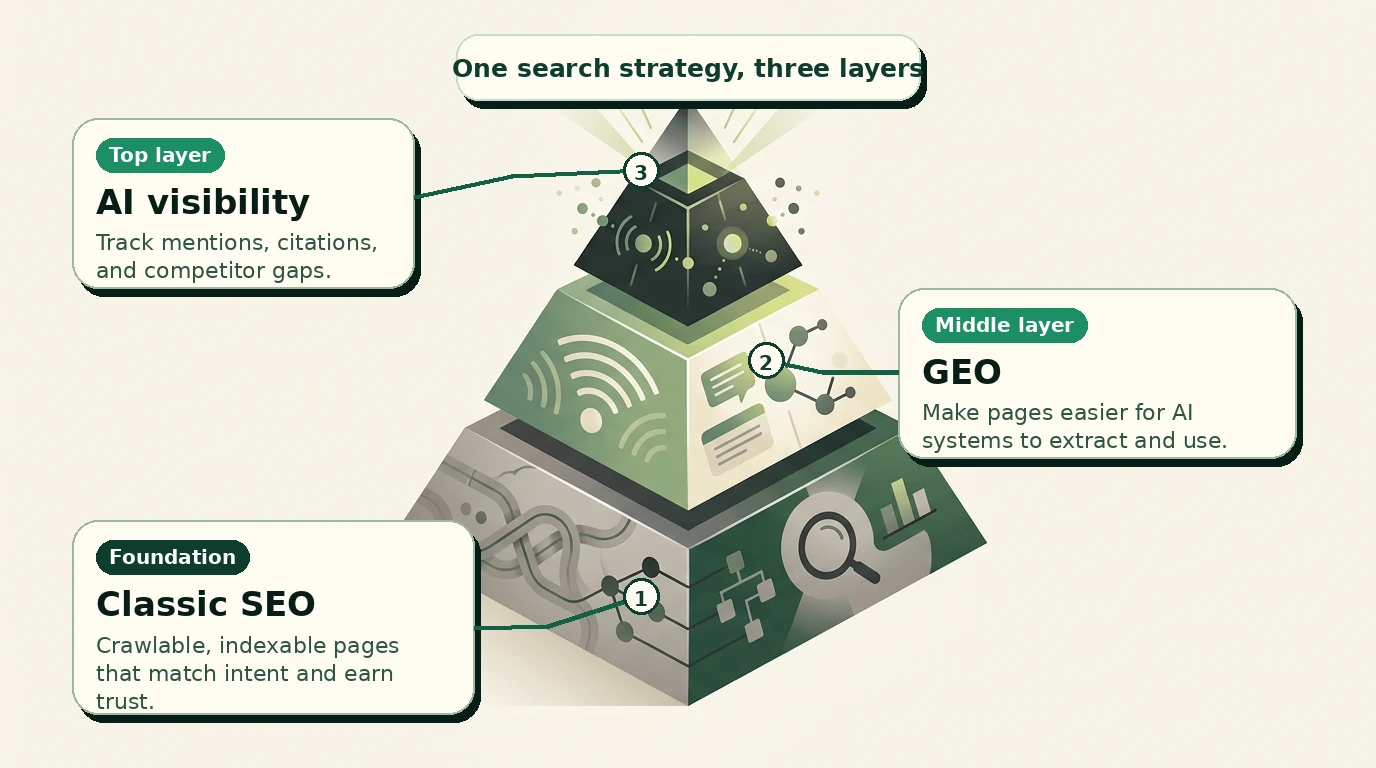
The pyramid is the simplest mental model: classic SEO is the foundation, GEO makes pages easier for AI systems to extract and use, and AI visibility measures mentions, citations, and competitor gaps.
Foundation
Classic SEO
Crawlability, indexability, search intent, internal links, and authority.
AI-ready layer
GEO
Clear answers, fan-out coverage, source-backed claims, and entity clarity.
Measurement
AI visibility
Track whether AI systems mention, cite, ignore, or replace your brand.
Think of it like this: do not start at the top of the pyramid. Build the SEO foundation, improve the page for AI extraction, then measure whether AI systems actually mention or cite you.
A practical workflow for small businesses
Step 1: Start with the classic SEO page target
Pick one page and one search intent. Do not start by asking, “How do I rank in ChatGPT?” Start with:
- What query or problem should this page solve?
- Is it informational, commercial, local, comparison, or transactional?
- What page type does the user expect?
- What are the top-ranking pages doing well?
- What can we add that is actually more useful?
DataWise angle: use Keyword Research and Competitor Analysis to decide which page deserves work first. If you are new to this, start with the guides on keyword research for small business and SEO competitor analysis.
Step 2: Check whether the page is technically eligible
Before worrying about AI citations, make sure the basics are not broken.
Check:
- Is the page indexable?
- Is it internally linked?
- Does the canonical point to itself or the correct canonical URL?
- Is important content visible as text?
- Does the page have a clear title, meta description, H1, and heading structure?
- Does structured data match the visible page content?
- Are images and videos useful, not decorative clutter?
Google’s AI features documentation says there are no additional technical requirements for appearing as links in AI Overviews or AI Mode beyond Google Search’s regular technical requirements. That is good news, but it also means you cannot skip the boring SEO work.
DataWise angle: use Site Audit to catch crawl, metadata, internal-link, and page experience basics before spending time rewriting content.
Step 3: Add GEO coverage with fan-out questions
Once the classic SEO target is clear, use fan-out to find the questions AI systems may ask behind the original query.
Example:
A user searches: “best SEO tool for small business”
An AI system may fan that out into:
- What features does a small business SEO tool need?
- How much should a small business pay for SEO software?
- What is the difference between DataWise, Ahrefs, and Semrush?
- Does the tool include keyword research, rank tracking, site audit, and AI visibility?
- Is the tool beginner-friendly?
- Does it help business owners act without hiring an agency?
A normal SEO page might target the head term. A GEO-ready page answers the decision path around the head term.
Use Fan-out Queries for this, then read the guides on what query fan-out means in AI search, using fan-out queries for blog outlines, and how fan-out queries help pages earn AI citations.
Important warning: do not paste fan-out questions into a page just to look comprehensive. Add your own insight, examples, screenshots, product-specific observations, and useful judgment. Google’s helpful, reliable, people-first content guidance asks whether content provides original information, analysis, or value beyond copying or rewriting other sources.
Step 4: Make the page extractable without making it robotic
Good AI-search content should be easy to quote, but it should not read like a glossary generated by a tool.
Use:
- Short answer blocks after major headings
- Specific examples
- Comparison sections
- Decision rules
- Step-by-step workflows
- Clear definitions
- Source-backed claims
- FAQs for leftover questions
- Product screenshots where they clarify the workflow
Avoid:
- Stuffing every related question into an FAQ
- Publishing generic summaries of the top 10 pages
- Making claims without sources
- Adding schema that does not match visible content
- Hiding key information inside images
- Optimizing for AI systems at the expense of the reader
Step 5: Measure AI visibility after the page is live
After the page is indexed and materially improved, run AI visibility checks.
Track:
- Does the brand get mentioned?
- Does the domain get cited?
- Which competitors appear instead?
- Which query variants trigger different answers?
- Are citations coming from the updated page or from older pages?
- Did the answer improve after the content refresh?
This is where DataWise closes the loop. It is not just “write content and hope.” The workflow is:
- Find the opportunity.
- Build or improve the page.
- Cover the fan-out.
- Check AI visibility.
- Refresh based on gaps.
Want one workflow for SEO and AI visibility?
DataWise gives small businesses and small agency owners the core SEO workflows without forcing you into a $100 to $500/month tool stack.
Inside the $27/month AI Ranking tier, you can use DataWise to:
- Research keywords
- Check competitors
- Audit pages
- Track rankings
- Find fan-out questions
- Monitor AI visibility
- Turn SEO data into content actions
DataWise starts at $27/month
Build pages for Google and AI search from the same workflow.
Use DataWise for keyword research, competitor checks, site audits, fan-out questions, rank tracking, and AI visibility monitoring without paying for a bloated enterprise SEO suite.
FAQ
Is GEO replacing SEO?
No. GEO builds on classic SEO. Google says its generative AI features are rooted in core Search ranking and quality systems, so crawlability, indexability, helpful content, internal links, page experience, and structured data still matter. GEO adds AI-answer-specific improvements such as fan-out coverage, clearer answer formatting, source-backed claims, and entity clarity.
What is the difference between AI visibility and GEO?
GEO is the optimization work. AI visibility is the measurement of whether that work is showing up in AI-generated answers. For example, adding clear answer sections and source-backed comparisons is GEO. Checking whether ChatGPT, Perplexity, or Google AI features mention or cite your site is AI visibility tracking.
What is the difference between AI visibility and AI citations?
AI citations are links to source pages inside an AI-generated answer. AI visibility is broader. It includes citations, brand mentions, product mentions, competitor appearances, and whether your brand is absent for important queries. A business may care more about being named in the answer than receiving a citation that users never click.
Should a small business optimize for ChatGPT, Perplexity, or Google AI Mode first?
Start with the platform most likely to influence your buyers, but do not create completely separate content strategies for each engine. The stronger base workflow is to build helpful, indexable, source-backed pages, cover the fan-out questions around the topic, then measure AI visibility across multiple engines.
How do I know if my SEO content is ready for AI search?
A page is closer to AI-search-ready when it is indexable, internally linked, useful for a real reader, clear enough to extract from, supported by credible sources, and comprehensive enough to answer the obvious follow-up questions. Then you need to measure whether AI tools actually mention or cite it.

Nicolas Gorrono
Founder of DataWise SEO and the AI Ranking community. Writing about SEO, AI search, and data-driven optimization.
Ready to turn this into action?
Use DataWise to find the next SEO opportunity
Join AI Ranking to get DataWise access, practical SEO workflows, live support, and a 7-day risk-free trial.